
Although Walmart-Flipkart wholesale game-plan is to target about a $150 billion market out of a total pie of $700 billion in the country, the consolidation marks the end of the multi-brand dream of the American retail giant.

Benchmark indices bounced back on Wednesday after a two-day decline, with the Sensex and Nifty climbing nearly 1 per cent each, tracking a positive trend in European markets. Buying in IT and bank stocks also supported the recovery in equities. The 30-share BSE benchmark jumped 547.83 points or 0.99 per cent to settle at 55,816.32.

The currency in circulation (CIC) declined by Rs 7,600 crore in the Diwali week, making it the first such happening in two decades, a report said on Thursday. This was made possible courtesy of a greater reliance on digital payments by people, the report by economists at SBI said, adding that the Indian economy is undergoing a structural transformation at present. They clarified that the Diwali week in 2009 had also witnessed a marginal Rs 950 crore decline in currency in circulation, but that was purely due to the economic slowdown amid the global financial crisis.

Benchmark Sensex rallied 455 points and Nifty rose more than 133 points to close above the key 18,000-mark for the first time since April on Tuesday as foreign institutional investors continued to be bullish on the domestic market. Continuing its rally for the fourth straight session, the 30-share Sensex rose 455.95 points or 0.76 per cent to close at 60,571.08 points. The broader Nifty climbed 133.70 points or 0.75 per cent to settle at 18,070.05 points. Previously, the Nifty had closed above the 18,000-mark on April 4 this year.

The telecom regulator on Friday released a list of 40 "defaulter" principal entities, including large banks like HDFC Bank, SBI and ICICI Bank, that are not fulfilling the regulatory norms on bulk commercial messages despite repeated reminders. Hardening its stance on the issue, the Telecom Regulatory Authority of India (TRAI) warned that defaulting entities should comply with the stipulated requirements by March 31, 2021 "to avoid any disruption in the communication with customers" from April 1, 2021. "As sufficient opportunity has been given to principal entities/ telemarketers to comply with the regulatory requirements and that the consumers cannot be deprived of the benefits of the regulatory provisions any further, therefore it has been decided that from April 1, 2021, any message failing in the scrubbing process due to non-compliance of regulatory requirements will be rejected" by the system, TRAI said in a statement.

The company would venture into khadi products and animal feed this year, Ramdev said.

Bulk of the medicine sales in the $22-24 billion domestic pharma market happens through offline retail chemists. With the entry of online pharmacies, this space has started to witness a shake-up. Sample this: Dawaa Dost, a Rajasthan based digital health start-up, generates medicine orders from 'kirana' stores and women self-help groups (SHGs) that operate in villages, and then service these orders through its affiliated network of pharmacies. Biddano, another health-tech start-up, has a platform that acts as an aggregator for neighbourhood chemist shops.

Dalal Street investors became richer by more than Rs 16.36 lakh crore this year as the equity market scaled new highs despite persistent geopolitical uncertainties and inflation worries. Analysts attributed better macroeconomic fundamentals, the confidence of retail investors and foreign investors investing again in the domestic equities towards the latter half of 2022 as the key factors that led to the outperformance of the Indian market in comparison to many other stock markets worldwide. During the initial part of the year, markets were jolted by the Russia-Ukraine war.

Equity benchmarks Sensex and Nifty halted their five-day rally on Tuesday and settled deep in the red, mirroring weak global markets, with decline in index heavyweights Reliance Industries, Infosys and HDFC Bank. Despite opening with gains of over 200 points, the 30-share Sensex turned highly volatile and tumbled 709.17 points or 1.26 per cent to close at 55,776.85. During the day, the benchmark index plunged 1,067.07 points or 1.88 per cent to 55,418.95. The broader NSE Nifty also declined 208.30 points or 1.23 per cent to close at 16,663.

We are working at putting the most modern technology in farms at Indian costs. I always say whatever the US implements in dollars we should be able to do it at exchange rate of Rs 10, then we would be globally competitive.

Most of the hirings are, however, in the entry or junior level.

Jio-BP, the fuels and mobility joint venture between Reliance Industries and UK's BP, on Thursday announced a partnership with BluSmart - India's first and largest all-electric ride-hailing platform - to set up a network of commercial large-scale EV charging stations. As part of the partnership, Jio-BP will set up these stations for passenger electric vehicles and fleets across the country, the company said in a statement. "Through this partnership, both companies will collaborate in planning, development and operation of EV charging infrastructure, at suitable locations across cities where BluSmart operates," it said.

The Tata Tech IPO will be the first from the Tata group since TCS listed its shares in 2004.

From the Sensex pack, Tata Motors, Sun Pharma, Wipro, Tata Consultancy Services, UltraTech Cement, Tech Mahindra, Bajaj Finserv, HCL Technologies, Infosys and IndusInd Bank were the major laggards. NTPC, Power Grid, Reliance Industries, Tata Steel, HDFC and HDFC Bank were the major winners.

American retail major Walgreens Boots Alliance on Tuesday said it would retain its pharma retail business - Boots UK - thus abandoning the entire sale process. The company did not make any comment specifically on the offer made by Mukesh Ambani-owned Reliance Industries (RIL), which had made a bid for the company last month. "As a result of market instability severely impacting financing availability, no third party has been able to make an offer that adequately reflects the high potential value of Boots and No7 Beauty Company.

Three business houses are likely to be in the final race to strike a deal with Germany's Metro AG for investing in its India unit -- Metro Cash & Carry. Industry sources in the know named Reliance, Adani Group, and Thailand's conglomerate Charoen Pokphand (CP) as potential frontrunners to acquire a partial or full stake in the Gurugram-headquartered Metro Cash & Carry, which has 31 stores and 5,000 direct employees. Around 20 companies, including strategic and private equity investors, were approached by the German chain, inviting them to bid for the Indian wholesale business, according to a source aware of the M&A developments.

Ambani's $15 bn bet will upend Indian telecom

With the markets scaling new highs, as many as 43 stocks from the Nifty50 index and 27 of the 30 scrips that are part of the S&P BSE Sensex are trading above their respective 200-day moving average (DMA). The 200-DMA is seen as one of the most relevant trend indicators by investors and traders, who believe that stocks and indices trading above this level possess strength and are likely to rally in the short to medium term, while the ones trading below this level are viewed as bearish and expected to see a sell-off. Wipro, UPL, Kotak Mahindra Bank, Hindalco, Infosys, Cipla, and Adani Enterprises are the only stocks from the Nifty50 pack that are still below their respective 200-DMA, the exchange data suggests.

Future group promoter Kishore Biyani's stake fell consistently across group companies since December 2019 after American retail major Amazon infused funds in a Future group promoter entity and the group companies started showing signs of financial distress due to closure of stores due to Covid-19 pandemic. As lenders take Future group companies to the bankruptcy courts to recover their dues under the Insolvency and Bankruptcy Code, the shareholders of Future group companies are staring at complete wipeout of their investments as secured lenders get top priority in any potential recovery, say lawyers. "The fate of all Future group shareholders is now sealed with them looking at a complete loss.

Equity benchmarks snapped their six-session rally to close marginally lower on Thursday amid profit booking in banking and energy counters. Investors also stayed on the sidelines ahead of the RBI's policy meet outcome on Friday. In choppy trade, the 30-share BSE Sensex ended 51.73 points or 0.09 per cent lower at 58,298.80. During the day, it hit a low of 57,577.05 and a high of 58,712.66.

Amazon provided mere "lip service" and failed to provide any help to the debt-laden Future Group as the retail major suffered massive setback amid the COVID-induced lockdown and faced possible insolvency or debt restructuring, Future Group's promoters said in a letter to the e-commerce giant. This is the first time Future Group promoters have written to Amazon after the parties were embroiled in a legal battle over the sale of Future's retail assets to Reliance Industries. The letter from the promoters, including Kishore Biyani, was written on December 31. It alleged that Amazon's actions "lacked good faith" during the March to August period, when the group's retail business was severely hit by the lockdown.

LIC's public offer, the country's biggest-ever IPO, saw the policyholders' portion being oversubscribed on the first day itself on Wednesday, though overall subscription stood at just 66 per cent. The government aims to generate about Rs 21,000 crore by selling 3.5 per cent stake in the insurance behemoth. The LIC initial public offering (IPO), open for retail and institutional investors, is set to close on May 9. The issue period also includes bidding on Saturday, May 7.

Equity markets extended their rally on Friday, with the Sensex and Nifty jumping over 1 per cent each, in tandem with a positive trend in global equities. Buying in Infosys and banking counters helped markets maintain their winning run. The 30-share BSE Sensex rallied 632.13 points or 1.17 per cent to settle at 54,884.66.

Since the Centre tightened the Press Note 3 norms in April last, as many as 150 private equity/venture capital investment applications from China and Hong Kong are pending with the government, starving the country's start-up ecosystem of funds, says a report. The Press Note 3 (PN3) changes were effected in April, restricting foreign direct investment from countries that share land borders with India. Analysts are of the view that the move was primarily aimed at China as lot of private funds were investing billions into domestic companies.

Equity benchmark Sensex slumped over 1,000 points to sink below the 55,000-level on Friday, tracking deep losses in IT, finance, banking and energy stocks amid widespread selling in the global markets. A weak rupee, surging crude prices and relentless foreign capital outflows further weighed on sentiment, traders said. The 30-share BSE index ended 1,016.84 points or 1.84 per cent lower at 54,303.44.

Among the Sensex firms, Kotak Mahindra Bank, Tata Steel, ITC, ICICI Bank, Bajaj Finserv, Maruti, Mahindra & Mahindra and State Bank of India were the biggest winners. Tata Consultancy Services, Infosys, HCL Technologies, Tech Mahindra, Asian Paints, Wipro and Tata Motors were the biggest laggards.

Equity investors became richer by over Rs 7.21 lakh crore as stock markets continued the rally for the second day on Wednesday. The 30-share BSE Sensex opened in the green on Wednesday and further jumped 1,469.64 points or 2.75 per cent to 54,893.73 during the day. It finally settled at 54,647.33, higher by 1,223.24 points or 2.29 per cent amid reports of diplomatic efforts to end Russia's attack on Ukraine. On Tuesday, it settled at 53,424.09, higher by 581.34 points or 1.10 per cent.
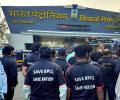
Privatisation of BPCL, which was dubbed India's biggest ever, has been stalled with just one bidder left in the fray after two others walked out over issues such as lack of clarity in fuel pricing, a top source said. The government had planned to sell its entire 52.98 per cent stake in Bharat Petroleum Corporation Ltd (BPCL) and invited Expression of Interest from bidders in March 2020. At least three bids came in by November 2020 but only one remains now after the others withdrew from the race.

Jio Platforms is expected to use its 388 million mobile phone subscribers as the cornerstone of an e-commerce and digital services business to rival Amazon and Walmart's Flipkart.

Benchmark BSE Sensex on Tuesday gave up intra-day gains to close lower by a little over 100 points on emergence of fag-end selling in FMCG, banking and IT stocks and weak opening in European stock markets. The 30-share BSE index declined 100.42 points or 0.19 per cent to settle at 53,134.35. During the day, it jumped 631.16 points or 1.18 per cent to 53,865.93.

Oil-to-telecom conglomerate Reliance Industries (RIL) has emerged as the country's largest wealth creator, adding a staggering Rs 9.6 trillion over the past five years, according to Motilal Oswal's 26th Annual Wealth Creation Study. In doing so, the Mukesh Ambani-led company has beaten its own record of Rs 5.6 trillion generated in 2014-19. The study covered financial year 2015-16 (FY16) to FY21 and ranks the top 100 companies in descending order of absolute wealth created, subject to the company's stock price outperforming the BSE Sensex. The firms were also ranked according to speed (price CAGR during the period).

Investors are showing some interest in the downstream energy cycle. Refiners and marketers, especially the public sector (PSU) oil marketing companies (OMCs) could see a revival of marketing margins. Lower crude oil and gas prices may also improve margins in industries like paints, logistics, synthetic fabrics, plastics, and fertilisers. In the medium-term, however, there could be a supply overhang affecting OMCs as new refining capacities are scheduled to be commissioned, especially in China, and this may lead to a drop in the refining margins as capacity would be surplus to demand until and unless there's a pick-up in global growth.

A platform that helps retailers reduce failed transactions while keeping the cost down, Innoviti is all set for India's digital payments revolution.

Reliance Industries, India's largest company by market capitalisation, and GAIL India, the largest transporter and marketer of gas, have sought licences to sell natural gas to households and vehicles across 60 cities in India.

Flipkart will need $2 bn annual profit to make Walmart investment viable, which will mean yearly revenue of $100 bn
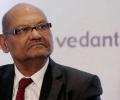
Mining magnate Anil Agarwal's conglomerate on Friday announced a major business shake-up, with flagship Vedanta Ltd approving a spin-off of its metals, power, aluminium and oil and gas businesses into separate listed entities and an overhaul of lucrative zinc unit planned as part of value creation and reducing debt load. Vedanta will issue one share of the five demerged businesses for every share held in the company, the firm said in a statement. The entire exercise, which would require shareholder and lender approval as well as a nod from the stock exchanges and courts, is expected to be completed in 12-15 months, its president for finance Ajay Agarwal said.

The introduction of the two new products is an indication of the importance of India as a market.

Reliance's big-bang entry across the solar ecosystem will cut dependence on Chinese imports drastically. And Ambani's repeated emphasis that RIL's new energy foray will be 'a truly global business' points that his group is playing not just for a share of the Indian pie but to be the OEM in the larger 5,000 GW global market by 2030, points out Shailesh Dobhal.

Reliance Industries (RIL) was the top-performing index stock on Friday (May 26) and closed the day with gains of 2.8 per cent, against a 1 per cent rise in the benchmark S&P BSE Sensex during the day. RIL's performance on the bourses on Friday was, however, an exception, and the stock has struggled to beat the broader market for nearly two years now. The company's share price is currently at the same level as in September 2021, while the benchmark index is up 6 per cent in the period.

Online play is a priority now -- so far unthinkable in a business that's all about a meaningful interface with kirana stores.
